
Waiting
It was an appointment I made on a whim. My back and hip pain was nagging at me when we were fishing on the lake and I thought maybe at least there’s something that can be done about my hip. I’d seen a spine specialist several times, completed multiple rounds of physical therapy and tried numerous pain relieving and anti-inflammatory medications. I tried diet changes, expensive supplements, and strength training, without much improvement.
The physical therapy was helping my back, at least I was pretty sure. The grade 1 spondylolisthesis in addition to the scoliosis and degenerating discs were not going away, but I was hopeful that I could avoid surgery, at least for a while. But the hip pain was something that I just couldn’t get any relief from. Surely I must have torn something, or have something separate going on that with the right information could be repaired.
The day of my appointment with the hip specialist came while my husband was away at a conference. My teenage son came with me for moral support. I had prayed that morning that I would accept if there was nothing to be done about my pain, but if not, that my perspective on pain would be changed.
To my surprise, the doctor was able to do x-rays right in the office. It didn’t take long for him to come back in with the images. The first thing he asked was unexpected. With a concerned look he asked if I’d been having fevers, fatigue or night sweats. I told him I had not although I questioned myself and glanced at my son to see if his concern matched mine. It didn’t.
He went on to explain that there was nothing to be done about my hip. He bluntly stated that my back was a mess and the pain was referred, but this spot on my femur had to be looked at. My mind was racing and I knew I wouldn’t remember the terminology he used, but he refused to write down what he was describing so that I wouldn’t have to try to remember how to properly explain to my husband. I still can’t remember how he described it initially, whether it was a cyst, or lesion, or something else I hadn’t heard of before. I didn’t feel like he was being very clear but I understood that the concern was urgent. I was to get an MRI then return to meet with him again. I was so disappointed, and now also scared.
My eyes were stinging as we left the parking lot and headed home. I didn’t want to worry my son, but there was no hiding how I was feeling. In his young wisdom, he reminded me that it could be nothing. His main observation was how my pain had been dismissed and thought I should see a different doctor. Inside, I was crumbling. My husband was in the process of a long drive home and I hated the thought of giving him a reason to worry on the way, but I couldn’t wait to call him. He was calm and supportive, just as expected.
So the waiting began. Crippling anxiety has been a thorn in my side for as long as I can remember, to the point of disrupting my activities and ambitions even as a young child. As an introvert and empath I have teetered on the edge of depression through various phases of life. Thankful to have medication to help allow me to continue to eat and take care of myself, I trusted that God had plans for this situation and dove deeply into creating resources for mentors. I found great comfort in Scripture and knew that, like us all, my family and I were not exempt from the trials of life. Paul experienced stress and suffering that are beyond comparison to my life, but his faith gave me confidence. In his letter to the Romans, he said:
Therefore, having been justified by faith, we have peace with God through our Lord Jesus Christ, through whom we also have obtained our introduction by faith into this grace in which we stand; and we celebrate in hope of the glory of God. And not only this, but we also celebrate in our tribulations, knowing that tribulation brings about perseverance; and perseverance, proven character; and proven character, hope; and hope does not disappoint, because the love of God has been poured out within our hearts through the Holy Spirit who was given to us. Romans 5: 1-5
Peter wrote about trials as well, saying:
In this you greatly rejoice, even though now for a little while, if necessary, you have been distressed by various trials, so that the proof of your faith, being more precious than gold which is perishable, even though tested by fire, may be found to result in praise and glory and honor at the revelation of Jesus Christ; and though you have not seen Him, you love Him, and though you do not see Him now, but believe in Him, you greatly rejoice with joy inexpressible and full of glory, obtaining as the outcome of your faith the salvation of your souls. 1 Peter 1:3-8
After 10 days of waiting for the MRI and then the results, it was determined that the abnormal spot on my femur was an atypical presentation of an osteoid osteoma, a benign bone tumor. Nothing needed to be done. I did not have Multiple Myeloma, as was described to me as one of the possibilities. Of course it was a tremendous relief. But there was something else. That waiting – it changed me, and my husband, too. It brought into focus the divine purpose that we already knew to be true – whether we are in the figurative eye of a category 5 hurricane or living any average day, our purpose is clear.
Purpose in waiting
We all need a sense of purpose. Maybe you know someone who is lacking a sense of purpose. What do you notice about the theoretical fruit of their lives? Maybe it’s you who lacks purpose.
Or maybe a person’s purpose is self-focused. Chances are they don’t mean to be that way, but the world revolves around their own needs, limiting causes for worry, or generally making things easier. Is that you?
Some of us dive into our work, politics, raising kids, furthering our education, social or societal issues, or fight for a cause greater than ourselves. Is this enough?
Viktor Frankl had every reason to be bitter. He endured three terrible years in a Nazi concentration camp, suffering trials beyond our imagination and losing most of his family in the process. His observations were poignant and changed my perspective as I read his book, Man’s Search for Meaning several years ago. Frankl says,
“As we saw it, a man who let himself decline because he could not see any future goal found himself occupied with retrospective thoughts. In a different connection, we often heard a man say, ‘I have nothing to expect from life anymore.’ But we were not prepared for hearing such a sentence from a man. We had to learn ourselves and, furthermore, we had to teach the despairing men, that it did not really matter what we expected from life, but rather what life expected from us.”
One of the most impactful pieces of advice I was ever given about marriage and relationships in general was about expectations. Although I don’t recall where I heard it or an exact quote, the message was clear. It wasn’t that I needed to lower my expectations for other people, it was that I had unspoken or even unnecessary expectations for others that caused me to feel let down. While there is a time for us to focus on ourselves, sometimes our expectations can cause undue trouble.
What do you expect out of your life? Staying healthy? The opportunity to see your children grow up and find success? A plentiful retirement account? Completing a bucket list? A certain number of years of life?
Although I’ve thought about these ideas in a faith-related context for years, the waiting I experienced lately made me look at my expectations with a magnifying glass. What are my expectations? What do I deserve out of life?
2 Corinthians 5:1-10 gives us many things to consider. Paul says,
For we know that if the earthly tent which is our house is torn down, we have a building from God, a house not made with hands, eternal in the heavens. For indeed in this house we groan, longing to be clothed with our dwelling from heaven, inasmuch as we, having put it on, will not be found naked. For indeed while we are in this tent, we groan, being burdened, because we do not want to be unclothed but to be clothed, so that what is mortal will be swallowed up by life. Now He who prepared us for this very purpose is God, who gave to us the Spirit as a pledge. Therefore, being always of good courage, and knowing that while we are at home in the body we are absent from the Lord – for we walk by faith, not by sight – we are of good courage, I say, and prefer rather to be absent from the body and to be at home with the Lord. Therefore we also have as our ambition, whether at home or absent, to be pleasing to Him. For we must all appear before the judgment seat of Christ, so that each one may be recompensed for his deeds in the body, according to what he has done, whether good or bad.
Once Paul was changed by his visit from the Lord, his expectations for his life were completely different. In the previous chapter of his letter to the Corinthians, he says regarding his suffering and experiences,
Therefore we do not lose heart, but though our outer man is decaying, yet our inner man is being renewed day by day. For momentary, light affliction is producing for us an eternal weight of glory far beyond all comparison, while we look not at the things which are seen, but at the things which are not seen; for the things which are seen are temporal, but the things which are not seen are eternal. 2 Corinthians 4:16-18
Despair has an opportunity to gain a foothold when we resist our eternal purpose. Our earthly existence is in a broken world, in a body that is deteriorating and surrounded by people who are trying to come to terms with the same things that we are. We look to science to explain and then re-explain when something new is understood, seeking answers to mysteries that we are not meant to fully comprehend in this life. But we are soul more than body with an eternal existence whose purpose far outweighs the temporal. Designed to be forever with Christ and given a free gift to atone for our imperfectness, our primary goal should be living a life that brings Him glory while we represent Him here for the time being.
We tend to seek to fulfill our needs through relationships, work, children, hobbies, wealth or service, but they will always bring disappointment. We tend to have expectations for God and what He should do for us or what we believe that He owes us. God spoke through the prophet Isaiah centuries before the birth of Christ, and his words help us understand our purpose as a race even then:
Seek the Lord while He may be found; call upon Him while He is near. Let the wicked forsake his way and the unrighteous man his thoughts; and let him return to the Lord, and He will have compassion on him, and to our God, for He will abundantly pardon. “For My thoughts are not your thoughts, nor are your ways My ways”, declares the Lord. “For as the rain and the snow come down from heaven, and do not return there without watering the earth and making it bear and sprout, and furnishing seed to the sower and bread to the eater; so will My word be which goes forth from My mouth; it will not return to Me empty, without accomplishing what I desire, and without succeeding in the matter for which I sent it. Isaiah 55:6-11
Our purpose should be Him. Our expectation on His return. Our responsibilities on the fulfillment of His will for our lives until our death or His coming. The opposite of what we have in mind regarding our expectations of what He should do for us.
Strategies in waiting
So what does this look like in the life of a believer? From my research and personal experience I propose three essential strategies for the life of a growing Christian. None of us are exempt from trials in life, and I would suggest – or even implore – that you begin to implement these strategies before the inevitable trial comes so that when the day of battle arrives you are already wearing your armor, although it will may benefit from some adjustments.
1. Consistent Scripture reading
Our study of God’s word is the foundation of our relationship with Him. To grow in our knowledge of Him, we must desire to know what His word says. To be obedient, we have to know the instructions for living.
Learning more about the story of humanity and God’s role in it must become the personal responsibility of a believer. When we rely solely on others to teach us, issues may develop, the most concerning being that our faith is not our own. Spending time independently in God’s word lets us see firsthand how His plans have unfolded throughout the course of history.
As I have studied through the Bible independently and consistently over the past 12 years, I have found several things to be helpful that I like to share with others.
- Use a hard copy, and write in it.
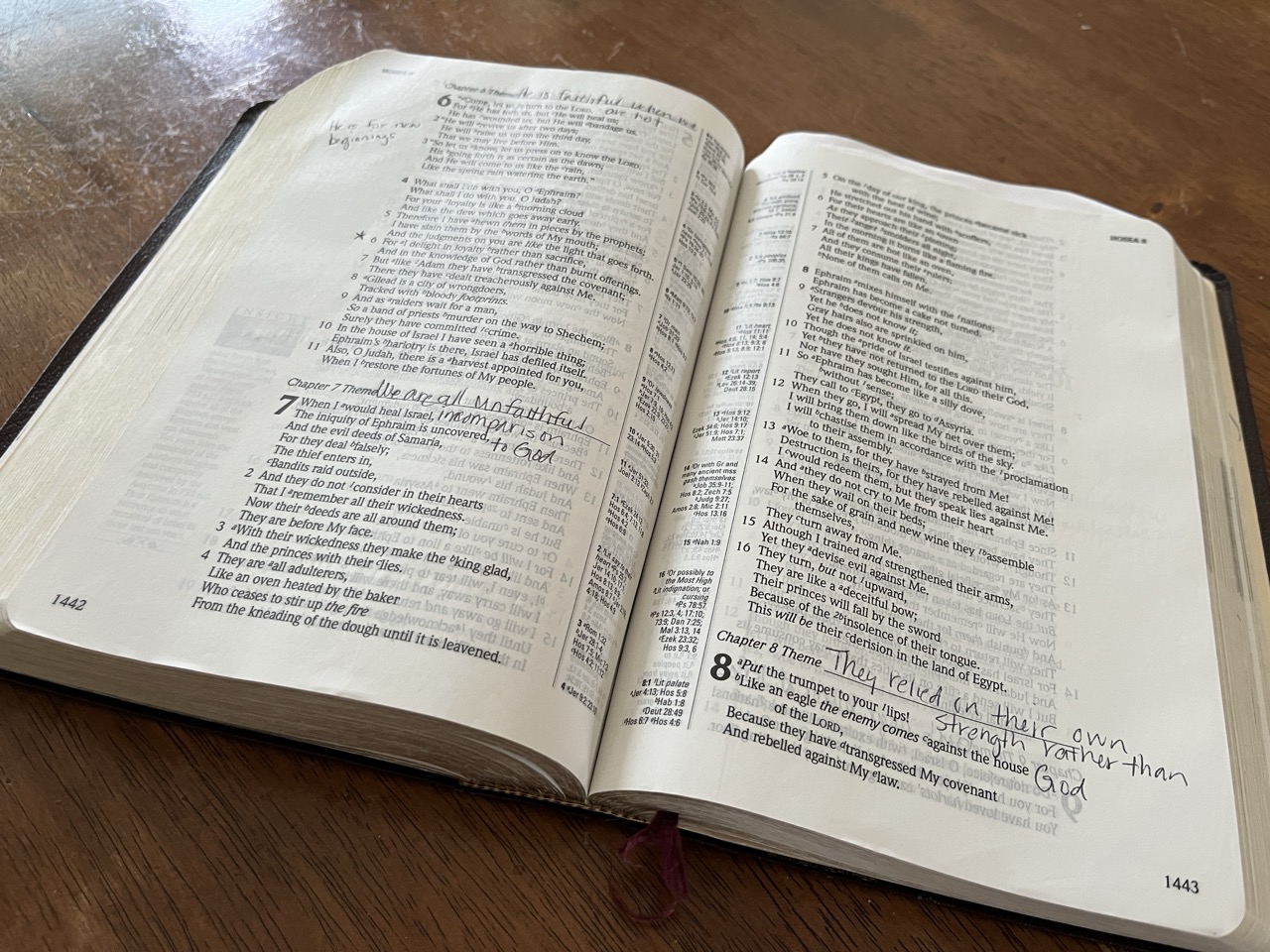
- My Bible is full of notes, including references to other passages that are related, things that have stuck with me from sermons or studies, and passages that are underlined, starred, or otherwise emphasized in some way from a time that it stood out to me. As I have been creating materials for mentoring, the passages that I reference are ones that have been meaningful to me over time and are notated as such in my Bible. I have a few passages that I dated – a reminder that we lived that very thing at that point in time and that God continues to be faithful even when we don’t understand.
- Use a version that you understand.
- Different translations have different reading levels. There is no shame in using a children’s Bible or a student version. Many versions are translated at a reading level of grade 11+, and the KJV is grade level 12. This is on par with challenging academic literature and overwhelming to a huge portion of the population, considering the reading level of the average American is between grades 7 to 9. For example, while Paul’s words are incredibly meaningful and wise, the passages can be overwhelming. The sentences tend to be quite long and include many things to consider. Here is a great resource to learn about the different translations available and what might be right for you: https://www.biblegateway.com/learn/bible-101/bible-versions-guide/. This is the Bible I’ve been using and writing in for at least five years with blank subject lines. You can see in the image at the top of the page how I write a theme for each chapter. FYI- I receive no compensation from sharing – simply an option for you to consider.
- Consider a chronological Bible.
- One of my long term read-throughs was using a chronological version of the Bible, and while not my go to copy to take to church or a small group with me (it can be extra hard to find specific passages), gaining an understanding of various retellings of events and the context around them was transformative for me.
- Use a version where you write in the “subject” of the chapter yourself.
- This is another concept that I stumbled upon but has ended up being incredibly meaningful to me. As I read through this version of the Bible, I wrote my own theme on a blank line next to the chapter number. I had never seen a version like this before but thought it was worth a try. Not only did it cause me to think deeply about the passage in order to properly summarize it into a heading, it serves as a reminder that I had read that passage. Although overwhelming at first, over time, I had a summary for every chapter of the Bible.
2. Prayer journaling
God began preparing me in a new way for an unexpected path beginning in 2012, when I was pregnant with my youngest child. To this day I’m not sure what prompted me to start this practice, but I started making sure I was the first one up in the mornings to have time alone reading my Bible and in prayer.
Being the forgetful person that I am, prayer journaling seemed like a smart way to acknowledge God’s work in my life over time. Every filled journal is a story of His faithfulness in my life – not meaning that He answered all my prayers how I expected, but that He has changed ME. He was with me through every joy, every heartache, and everything in between. I have a record of over a decade of prayers, some of which represent times of grief and suffering for the sake of things He called us to do. And I can look back and see how he was working in my heart the whole time. Below you can see my journals dating back to July 2022.
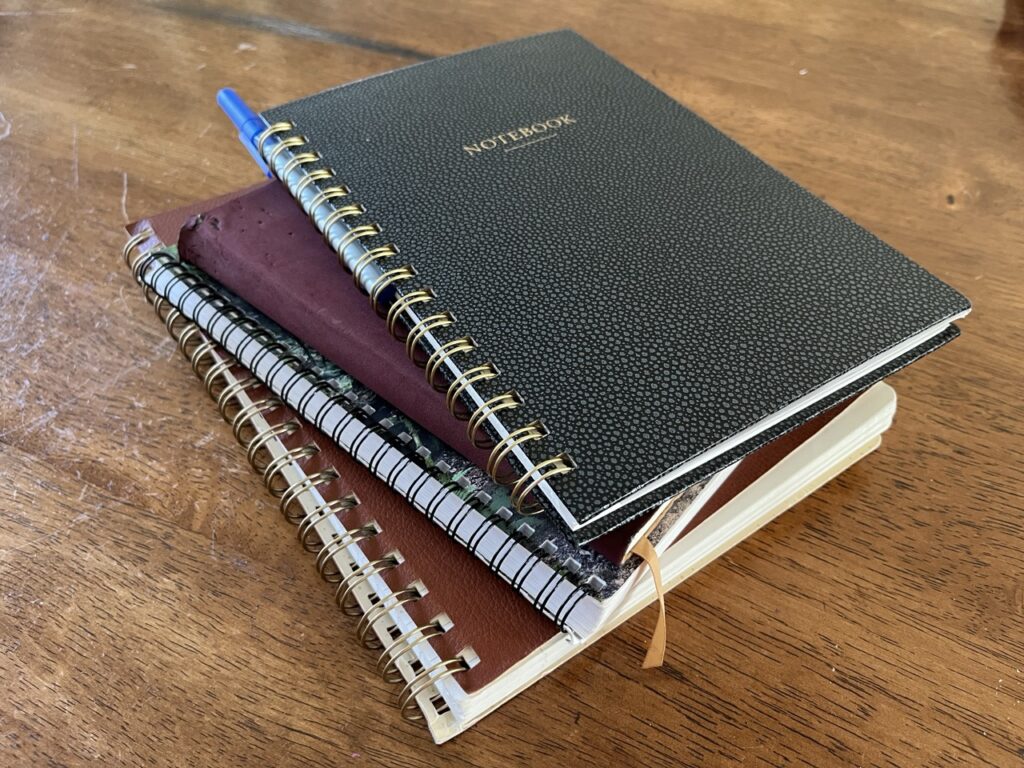
Praying is GOOD, and we are called not specifically to prayer journal but to a lifestyle of prayer without ceasing (1 Thessalonians 5:17) which would obviously be difficult to sustain in journal form! But I speak from experience when I say that it has greatly contributed to the growth of my faith as a part of my walk with God.
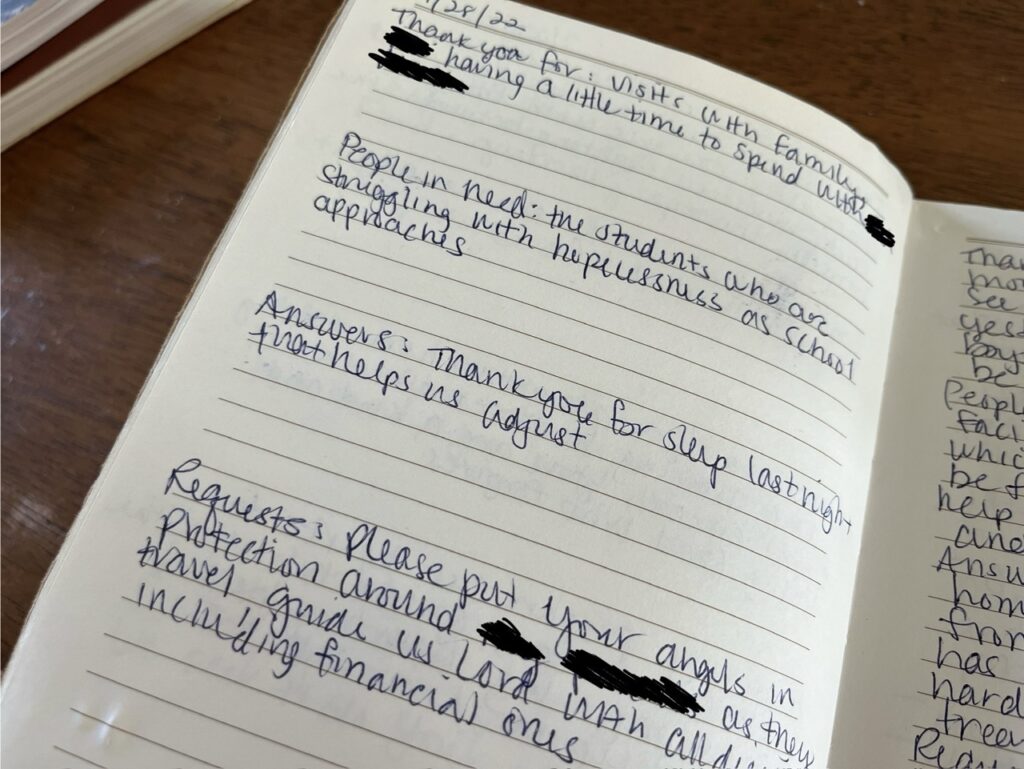
There are unlimited methods for prayer journaling. Any type of journal that you like is fine. I have used the method of writing four categories of things down for years now: thank you for…, people in need, answered prayers, and prayer requests. Sometimes I don’t follow this pattern and write whatever I’m thinking. After I write everything down I pray it aloud, preferably in a whisper (one reason why I like to be the first one up). I also jot down sermon notes in my journals. Some days I fill the page, other days I write very little. And that’s ok.
3. Fellowship
This is where it gets messy, right? Because while we may do our best to represent Christ, we are imperfect. We say things we shouldn’t. We leave people out. We act like hypocrites. We generally make mistakes. But nevertheless, we are called to be together.
Many times, maybe even a majority of the time, the Church does not do a very good job of representing our Savior and we drive people away. It’s also worth considering that a portion of the population of any given congregation may be acting not out of the love of Christ, but out of selfish motives. Sometimes it makes me wonder if they are a follower of Christ at all. It seems like Judas looked ok to the others until the end there…but thankfully, that final judgment is not mine or ours to make. Each of us will stand, alone, before our Creator one day and be accountable for our lives (read Romans 14).
Fellowship is more than going to church. Sometimes we don’t even have much fellowship when we go to church. A service itself provides some sense of community, but we also need deep and meaningful interaction between us to help sharpen us. Loving accountability from fellow believers, especially as we navigate challenging circumstances, can lead to tremendous periods of personal growth. We have a responsibility in the Church to disciple others, but we have a tendency to become overly focused on our own needs. There are seasons when we need the guidance of others, but there are also seasons when it is our turn to guide. We all need some of each. And we’re all waiting for something.
Concluding Thoughts
You don’t often hear folks refer to life as being an easy experience, but there are certainly times when things are more difficult than others. Our expectations for how things would go often turn out to be a disappointment. So much of the human experience is simply out of our control.
Fortify yourself. Be proactive in your growth as a believer so that when those inevitable trials come, you have hope and purpose in the future – whether in life or death. Be the disciple, or mentor, that another needs so that they can have hope and purpose in each day, too.
Maybe you didn’t fortify yourself, and you’re now in the trial. It’s never too late. Open your Bible. Reach out for help if needed. (We all need it.) There are people who can walk beside you and help you take steps of faith even in the most difficult of circumstances. We all need a purpose much greater than anything the physical realm has to offer. The suffering of this world is just too much to bear without it.
We have hope in the future. Paul says in Romans 8:18 – “For I consider that the sufferings of this present time are not worthy to be compared with the glory that is to be revealed to us”. We have a purpose here amidst the joys and challenges of life that is far greater than ourselves. Our expectations can fool us into a false sense of purpose, one that simply doesn’t hold up in the end.
Get involved. Rise Up Daughter is a great place to start. We can all use some support and have a responsibility to disciple others. Learn more here. Even once you’re trained as a mentor, there is no obligation – you simply use the skills, knowledge and resources you gain as God calls you to use them.
What are you doing while you’re waiting?
Leave a Reply